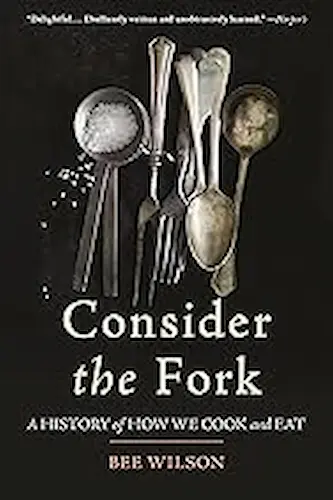
Consider the Fork: A History of How We Cook and Eat
by Bee Wilson
You have used a fork approximately three times today without thinking about it once. Bee Wilson would like to change that. Consider the Fork is a full-length book about the history of cooking implements — knives, spoons, pots, pans, ovens, measuring cups, the fork — and the ways in which these tools shaped not just how we cook but how we eat, think about food, and structure our lives around meals.
This sounds like it might be dry. It is not dry. Wilson is a genuinely gifted food writer who approaches kitchen technology the way a cultural historian approaches anything: as a lens through which to understand broader human behavior. The fork, for instance, was deeply controversial when it arrived in Europe — accused of being effeminate, unnecessarily fussy, a sign of weakness. It took centuries to become standard. Someone actually objected to the fork as a lifestyle choice.
The history of the knife is even more interesting, the history of fire more elemental, and the history of the refrigerator more recent and more transformative than most people realize. Each chapter reframes something ordinary as a design object with a history, a set of cultural assumptions baked in, and a series of choices that could have gone differently.
It’s the book that makes you look at your kitchen with new eyes, which is either enriching or unsettling. Probably both. Consider the fork.