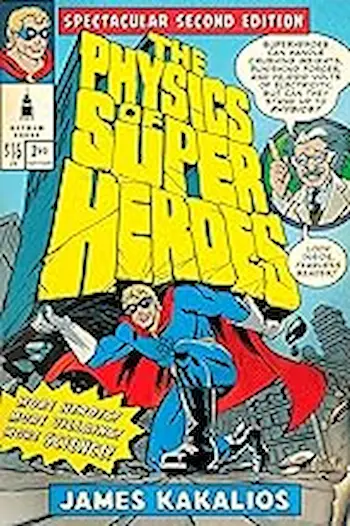
The Physics of Superheroes
by James Kakalios
James Kakalios is a physics professor at the University of Minnesota who got tired of students asking when they’d ever use this stuff in real life. His answer: Spider-Man. Specifically, the tensile strength required for a web to catch a falling person without snapping their spine. This is a real calculation. It appears in a real physics textbook. The textbook is this book.
The Physics of Superheroes uses comic book scenarios as the entry point for actual, college-level physics concepts. Flash’s speed? Let’s calculate the kinetic energy. Superman’s jump height on Krypton? Gravity mechanics, explained through the lens of someone who could theoretically bench-press a building. The Atom shrinking to subatomic size? Quantum effects, and why he’d actually just fall through everything.
What Kakalios brings — beyond the obvious appeal of comic books as a teaching vehicle — is genuine enthusiasm for both subjects. He’s not using superheroes ironically. He clearly loves them, and he clearly loves physics, and the combination produces explanations that feel energetic rather than pedagogical.
The result is a book that teaches real physics through questions people actually want answered. It works because asking “why doesn’t Spider-Man’s web rip Gwen Stacy in half?” is a better motivator for learning impulse-momentum than any textbook problem about a ball rolling down a ramp has ever been. Apologies to the ball.